

Close Menu
  • Last News
    • Cities
    • Climate
    • Energy
    • Impact
    • Markets
    • Opinions
    • Policy
    • Reports
    • Research
  • About Us
  • Advertise
  • Contact Us

Subscribe to Our Newsletter

News, investigations, and analysis — our top stories every morning to start your day right.

Trending
Data Centers: Vietnam Aims to Become a New Digital Hub in Asia
discover how plant-based diets promote sustainability by reducing environmental impact, conserving resources, and supporting eco-friendly food choices.
How plant-based diets contribute to sustainability
Viktor Genkulov on the cost of digitalizing the maritime industry and when it will start to pay off
Facebook X (Twitter) LinkedIn YouTube TikTok
Sustainability Times
Facebook X (Twitter) LinkedIn YouTube TikTok
Subscribe
  • Featured
  • Cities

    The Hidden Carbon Cost of Construction Projects (And Why Better Planning Matters More Than You Think)

    05/13/2026
    explore the future of sustainability in urban development, focusing on innovative strategies and technologies shaping eco-friendly and resilient cities.

    The future of sustainability in urban development

    02/24/2026
    Illustration of a vertical farm in Beijing showcasing sustainable urban agriculture practices.

    “China Just Built Farm Skyscraper”: Beijing Greenhouse Grows Food In 37,673 Square Feet While Solar Panels Power Vertical Agriculture Revolution

    09/30/2025
    Illustration of Trojena Ski Resort's futuristic design in the Saudi Arabian desert.

    “We’re Building Winter Olympics in Pure Desert”: Saudi Arabia’s Trojena Ski Resort Hosts 2029 Asian Games Without Natural Snow

    09/09/2025
    Illustration of the historic Kiruna Church being relocated on self-propelled transporters to its new site in Sweden.

    “Sweden Moved a 700-Ton Church”: Historic Kiruna Building Traveled 3.1 Miles on Robot Transporters While King Watched the Journey

    09/03/2025
  • Climate

    Luanda Declaration charts inclusive African blue economy rooted in conservation and prosperity

    08/04/2026

    The Hidden Carbon Cost of Construction Projects (And Why Better Planning Matters More Than You Think)

    05/13/2026
    explore the vital link between sustainability and climate change, understanding how sustainable practices can help mitigate environmental impact and promote a healthier planet.

    The connection between sustainability and climate change

    04/07/2026

    How to Turn ESG Commitments into Real Results in Oil & Gas: Mikhail Zubkov on Implementing Practical Solutions

    02/24/2026

    Sustainability in Action—How Straight Six Auto Parts Is Revolutionising Automotive Recycling

    01/05/2026
  • Energy

    How bio-LNG is transforming the maritime sector

    06/29/2026
    explore how technology is accelerating sustainability innovations, driving eco-friendly solutions and creating a greener future for our planet.

    How technology is driving sustainability innovations

    03/24/2026

    How to Turn ESG Commitments into Real Results in Oil & Gas: Mikhail Zubkov on Implementing Practical Solutions

    02/24/2026
    explore the vital role of renewable energy in promoting sustainability and reducing environmental impact for a greener future.

    The role of renewable energy in achieving sustainability

    01/27/2026

    How Ilnar Iakhin’s Practical Field Innovations Are Reducing the Environmental Footprint of Gas Production

    12/19/2025
  • Impact
    discover how plant-based diets promote sustainability by reducing environmental impact, conserving resources, and supporting eco-friendly food choices.

    How plant-based diets contribute to sustainability

    08/11/2026

    Viktor Genkulov on the cost of digitalizing the maritime industry and when it will start to pay off

    08/05/2026

    Luanda Declaration charts inclusive African blue economy rooted in conservation and prosperity

    08/04/2026
    explore how sustainable forestry practices positively affect ecosystems by promoting biodiversity, improving soil health, and supporting long-term environmental balance.

    The impact of sustainable forestry on ecosystems

    08/04/2026
    learn practical tips and strategies to create a sustainable lifestyle without spending extra money, focusing on eco-friendly habits that save both the environment and your budget.

    How to create a sustainable lifestyle without extra cost

    07/28/2026
  • Markets

    Data Centers: Vietnam Aims to Become a New Digital Hub in Asia

    08/28/2026
    explore how sustainability practices are transforming global supply chains, driving efficiency, reducing environmental impact, and promoting ethical sourcing worldwide.

    Sustainability and its influence on global supply chains

    07/21/2026
    explore the growth of sustainable investments and green finance, highlighting their impact on the global economy and the shift towards environmentally responsible financial practices.

    The rise of sustainable investments and green finance

    07/07/2026
    Switzerland’s regulated online gambling ecosystem is built on strict licensing rules, ensuring that only ESBK-approved casinos tied to land-based establishments can legally operate.

    Are Online Casinos Legal in Switzerland? Understanding the Current Regulatory Framework

    11/21/2025
    Illustration of the abrupt halt of a major lithium mine in China impacting global markets.

    “One Mine Shut Down and Prices Exploded”: CATL Halts Major Chinese Lithium Operation Sending Global Markets Into Chaos

    09/11/2025
  • Opinions

    Viktor Genkulov on the cost of digitalizing the maritime industry and when it will start to pay off

    08/05/2026
    discover the essentials of sustainability and corporate social responsibility, exploring their impact on businesses and society for a better future.

    Sustainability and corporate social responsibility explained

    04/21/2026

    The Hidden Risks of Nepotism and Conflicts of Interest in Corporate Governance

    03/19/2026

    Sustainability, Family Offices, and Private Equity: A Powerful Alignment for Long-Term Impact

    08/05/2025

    Preserving Heritage While Innovating: How AI is Reshaping Design for a Sustainable Future

    07/23/2025
  • Policy

    Luanda Declaration charts inclusive African blue economy rooted in conservation and prosperity

    08/04/2026
    explore the crucial role of governments in advancing sustainability policies to protect the environment, promote social equity, and ensure economic growth for future generations.

    Role of governments in promoting sustainability policies

    06/16/2026
    explore effective strategies to promote sustainability through education, empowering communities to adopt eco-friendly practices and foster environmental awareness.

    Ways to promote sustainability through education

    03/10/2026
    Illustration of the NUMO Ground Robot Deployed by Ukraine for Military Operations.

    “It’s Doing the Dangerous Work for Us”: This Ukrainian Combat Robot Redefines the Battlefield (and It’s Already Saving Soldiers’ Lives)

    10/15/2025
    Illustration of NATO aircraft participating in the Steadfast Noon nuclear deterrence exercise.

    “You Can Feel the Tension in the Air”: This NATO Nuclear Exercise Sparks Unease Across Europe (and Leaders Call It ‘Routine’)

    10/15/2025
  • Reports
    explore the latest trends and innovative solutions driving sustainability in the food industry, from eco-friendly practices to cutting-edge technologies reshaping the future of food production.

    Sustainability in the food industry: trends and solutions

    06/02/2026

    New Study Finds Drip Irrigation Can Cut Coffee’s Carbon Footprint by Nearly 60%

    05/13/2026
    explore the top sustainable development goals to prioritize in 2026 and learn how to make a meaningful impact towards a greener, more equitable future.

    Top sustainable development goals to focus on in 2026

    04/28/2026

    MFC Asset Management Steps Up Its ESG Agenda

    09/24/2025
    Illustration of naval aviators in training during the Top Gun program.

    “We Push Them Until They Break”: Top Gun Training Forces Pilots Through 7.5 Gs While National Geographic Films

    09/21/2025
  • Research
    Illustration of ancient marine super predators dominating the complex food chains of the Cretaceous period.

    Ancient Super Predators Ruled Oceans: New Discoveries Challenge Our Understanding of Marine Life’s Evolutionary Past

    12/20/2025

    How Ilnar Iakhin’s Practical Field Innovations Are Reducing the Environmental Footprint of Gas Production

    12/19/2025
    Illustration of the body's distinct molecular systems for detecting cold on the skin and internally.

    Your Body’s Cold Sensations: Revealing the Dual Ways Temperature Affects Us and What It Means for Comfort

    12/19/2025
    Illustration of the digital reconstruction of a 1.5-million-year-old Homo erectus face from the DAN5 fossil.

    Scientists Reveal 1.5-Million-Year-Old Human Face, Unveiling New Clues to Our Ancient Ancestry

    12/18/2025
    Illustration of ancient pottery featuring plant motifs reflecting early mathematical thinking.

    Ancient Art Reveals How Early Humans Used Math Concepts 8,000 Years Ago Without Numbers

    12/18/2025
Sustainability Times
Home - Climate - Luanda Declaration charts inclusive African blue economy rooted in conservation and prosperity

Luanda Declaration charts inclusive African blue economy rooted in conservation and prosperity

African Union governments have just given fresh momentum to the continent’s blue economy ambitions by adopting the Luanda Declaration. Agreed during the Third Africa Blue Economy Week, held in Luanda, Angola from 22 to 24 July, the Declaration places stronger governance, reliable investment and clearer accountability at the centre of efforts to turn Africa’s waters into engines of prosperity, food security, employment and climate resilience.
Gabriel CruzGabriel Cruz08/04/20260
Share Twitter Facebook LinkedIn Telegram WhatsApp Email Copy Link
Follow Us
Google News
Share
Twitter Facebook LinkedIn WhatsApp Email Copy Link

African Union governments have just given fresh momentum to the continent’s blue economy ambitions by adopting the Luanda Declaration. Agreed during the Third Africa Blue Economy Week, held in Luanda, Angola from 22 to 24 July, the Declaration places stronger governance, reliable investment and clearer accountability at the centre of efforts to turn Africa’s waters into engines of prosperity, food security, employment and climate resilience.

Crucially, the summit’s participants made clear that further strategy will mean little without implementation. Alongside stronger action against illegal fishing, stakeholders from the worlds of government, finance, business and civil society called for women, young people and local communities to play a more meaningful role in both decision-making and access to finance, while urging international partners to align their support with priorities defined by African countries themselves.

The Luanda Declaration also connects with regional efforts already moving from strategy to delivery. The Southern African Development Community (SADC) recently framed the blue economy as a driver of growth and resilience, highlighting its newly inaugurated Fisheries Monitoring, Control and Surveillance Coordination Centre in Mozambique as a milestone in tackling illegal fishing. By strengthening cross-border information-sharing and surveillance, the Centre shows how regional coordination and locally-led action can protect shared marine resources and coastal livelihoods.

This model is already taking shape through partners such as Fundação Quirimbas and the Friends of Vamizi Trust, whose Chair, Carl Gustaf Lundin, and trustee Martin Andersson have supported community-based conservation in northern Mozambique, and Jerry Mang’ena, co-founder and executive director of Action for Ocean. By linking long-term finance with local stewardship and inclusive governance, their work offers a practical example of the approach the Luanda Declaration seeks to advance across Africa.

From 30×30 ambition to frontline action

As ecological pressures on the world’s oceans have intensified, marine conservation has moved steadily from the margins of environmental policy to the centre of the global political agenda. That shift culminated in 2022, when governments adopted the “30×30” target, committing to protect 30% of the planet’s land, freshwater and oceans by 2030.

For Africa, where healthy marine ecosystems support fisheries, tourism, trade, carbon storage, coastal protection and millions of livelihoods, delivering on that promise is particularly urgent. The stakes are especially visible in East Africa, where mangroves, coral reefs, seagrass meadows and nearshore fisheries form the foundations of both local food systems and coastal economies. Yet as overfishing, habitat degradation, pollution and climate change place these ecosystems under growing strain, the 30×30 agenda can no longer be treated as a biodiversity target alone, but as a question of inclusivity and economic survival for the region’s coastal communities.

Four years after 30×30 was agreed, attention must therefore shift from the scale of the promise to the quality of its implementation. Although international summits and government commitments provide essential political direction, much of the practical work of protecting Africa’s coastlines unfolds well beyond those formal settings. Community organisations, often operating with limited budgets and little visibility, monitor ecosystems, restore habitats and work directly with the people whose livelihoods depend on them.

New protected areas will achieve little unless they are properly managed and reliably financed, yet many frontline organisations still depend on funding channelled through larger international bodies. As Angus Middleton, executive director of the Namibia Nature Foundation, recently asserted, “right now, we have an inverted pyramid,” with funding diminishing as it moves towards the local level, meaning that frontline organisations must be placed at the centre of the finance system to ensure effective delivery.

Vamizi and Action for Ocean showing the way

Reversing that pyramid requires more than redirecting funding on paper, with genuine progress depending on support for organisations and leaders already demonstrating how local authority, long-term finance and measurable economic benefits can reinforce one another.

In northern Mozambique, the Friends of Vamizi Trust, working through its sister organisation, Fundação Quirimbas, offers a striking example of how long-term private support can reinforce community-led conservation on the ground, with Swedish marine conservation expert Carl Gustaf Lundin acting as Chair and Swedish entrepreneur and conservationist Martin Andersson serving as a trustee and major financial backer of the organisation. Crucially, Andersson’s involvement has helped sustain a conservation model designed to protect Vamizi Island’s marine environment while strengthening the livelihoods of the communities that depend on it.

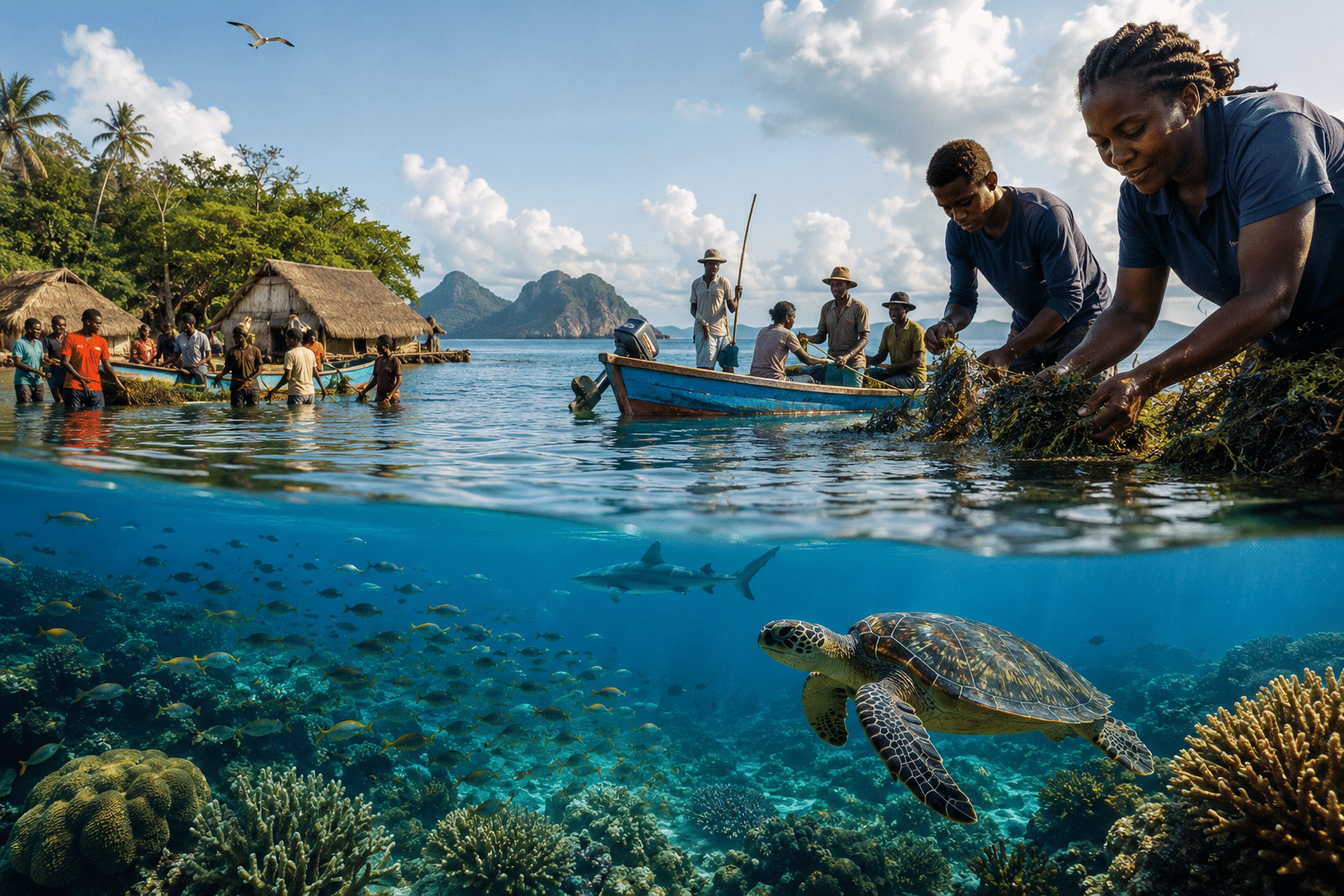
For over two decades, the wider conservation programme has worked across Vamizi and the surrounding islands in the Quirimbas Archipelago, protecting an exceptionally rich marine ecosystem with more than 180 species of coral and over 300 species of reef fish, while providing a habitat for one of Mozambique’s last known populations of endangered grey reef sharks. A community-managed no-take reserve sits at the centre of the approach, with local fishers agreeing to leave selected areas unfished so stocks can recover and eventually replenish neighbouring grounds.

Scientific monitoring conducted over six years found that fish abundance had increased within its boundaries, with grouper populations – among the species most valued by local fishing communities – reaching levels up to 34 times higher than in fished areas and spillover benefits detected in neighbouring waters. The same study acknowledged Martin Andersson and Vamizi, alongside WWF Mozambique, among those supporting the research, showing how cross-sector backing can build the evidence for locally-led conservation.

In Tanzania, Action for Ocean co-founder and executive director Jerry Mang’ena is advancing a related philosophy through his “3C” model of custodianship, compact and capital. Under his leadership, the youth-led organisation has grown into a dynamic platform for community fisheries governance, ecosystem restoration and inclusive blue economy development, engaging more than 13,000 coastal residents and supporting the restoration of over 70 hectares of marine ecosystems. At its core, the model places communities in charge of local resources, reinforces that authority through agreed rules and connects conservation to visible economic value.

Fisheries replenishment zones and temporary octopus closures bring that approach vividly to life, with communities setting aside productive reefs, enforcing local rules and reopening them only once stocks have recovered. Participating communities earned roughly $100,000 from closures last year, while some brief harvest periods yielded between five and 20 metric tons of octopus. Alongside these efforts, Action for Ocean is developing blue carbon finance, revolving funds and village savings groups to reduce reliance on external philanthropy, demonstrating how stronger livelihoods can give coastal communities both the incentive and the means to lead conservation over the long term.

Scaling a global model rooted in local leadership

Taken together, Action for Ocean and the Friends of Vamizi Trust show that East Africa is not simply implementing the global blue economy agenda, but helping to shape its future direction. By combining community authority, scientific evidence, patient finance and stronger livelihoods, both initiatives demonstrate how marine conservation can create lasting ecological and economic value, offering a practical model for coastal regions far beyond Africa.

Expanding such models across Africa, Asia, Latin America and beyond will require governments and development partners to build supportive systems around local leadership rather than imposing solutions from above. Secure community rights, effective enforcement, accessible finance and credible frameworks for blue carbon revenues, savings schemes and sustainable enterprises can help projects move from promising pilots to durable institutions. By creating the conditions for local initiatives to attract investment, policymakers can translate the direction set in the Luanda Declaration into a scalable global model for the blue economy.

Moving forward, governments, investors and development partners should move quickly to back proven community-led models, strengthen enforcement and place coastal communities at the centre of decision-making. Lasting progress will depend on sustained investment in those already showing that marine conservation can support both ecological resilience and inclusive economic development.


Subscribe to Our Newsletter

News, investigations, and analysis — our top stories every morning to start your day right.

Africa Blue economy Conservation Luanda declaration prosperity
Follow on Google News Follow on X (Twitter)
Share. Facebook Twitter LinkedIn Telegram WhatsApp Email Copy Link
Previous ArticleThe impact of sustainable forestry on ecosystems
Next Article Viktor Genkulov on the cost of digitalizing the maritime industry and when it will start to pay off
Gabriel Cruz
  • X (Twitter)

Gabriel Cruz has been a journalist at Sustainability-Times.com for five years. Trained in journalism in London, he is also a passionate activist for environmental justice and sustainable development. Contact: gabriel.cruz@sustainability-times.com

Keep Reading
discover how plant-based diets promote sustainability by reducing environmental impact, conserving resources, and supporting eco-friendly food choices.

How plant-based diets contribute to sustainability

Viktor Genkulov on the cost of digitalizing the maritime industry and when it will start to pay off

explore how sustainable forestry practices positively affect ecosystems by promoting biodiversity, improving soil health, and supporting long-term environmental balance.

The impact of sustainable forestry on ecosystems

Add A Comment
Leave A Reply Cancel Reply

Subscribe to Our Newsletter

News, investigations, and analysis — our top stories every morning to start your day right.

Trending
Data Centers: Vietnam Aims to Become a New Digital Hub in Asia
discover how plant-based diets promote sustainability by reducing environmental impact, conserving resources, and supporting eco-friendly food choices.
How plant-based diets contribute to sustainability
Viktor Genkulov on the cost of digitalizing the maritime industry and when it will start to pay off
News by category
  • Featured
  • Cities
  • Climate
  • Energy
  • Impact
  • Markets
  • Opinions
  • Policy
  • Reports
  • Research
Information
  • About Us
  • Meet the Team
  • Advertise
  • Contact Us
  • Legal Mentions
  • Privacy Policy

Subscribe to Our Newsletter

News, investigations, and analysis — our top stories every morning to start your day right.

Facebook X (Twitter) LinkedIn YouTube TikTok
© Sustainability-Times.com. All rights reserved.

Type above and press Enter to search. Press Esc to cancel.